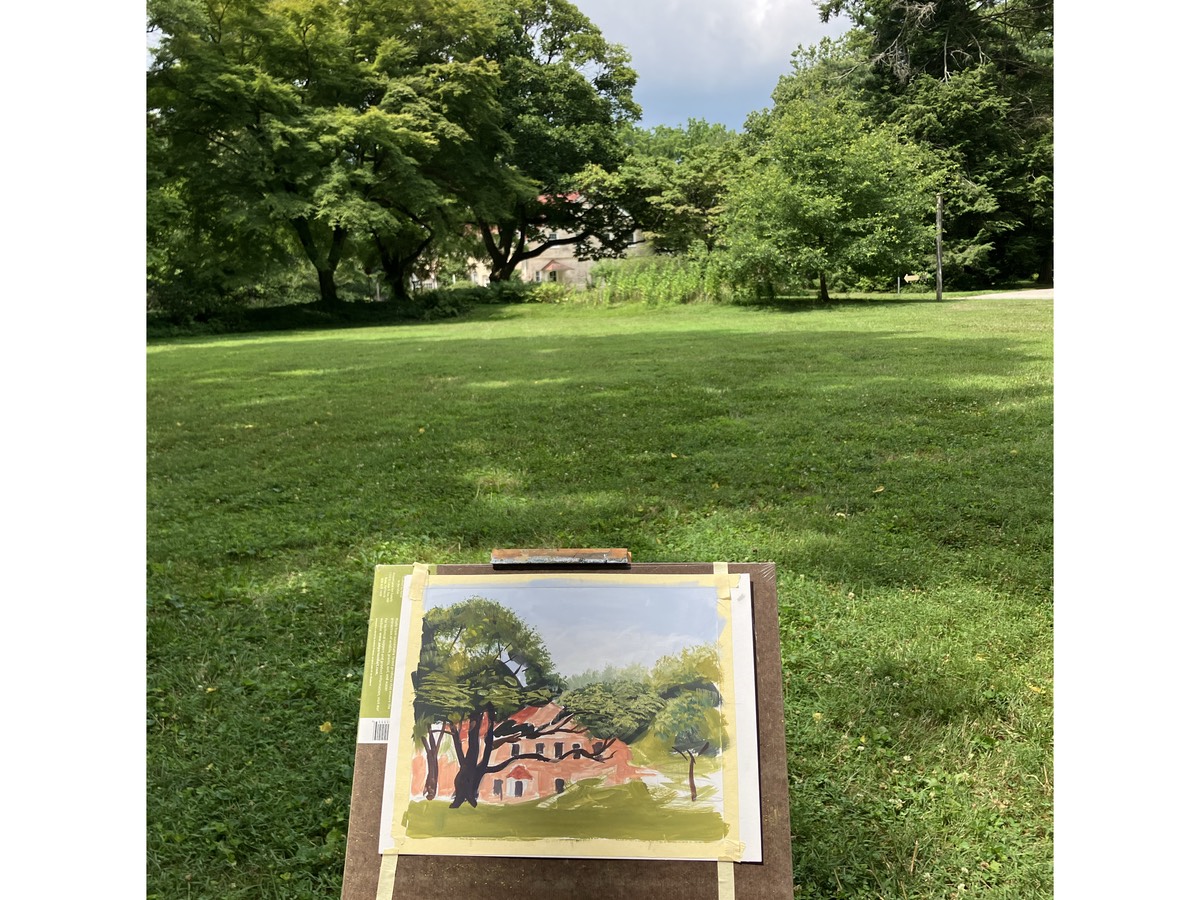
Wednesdays, June 24 – August 12, 2026, 9:00 am – 12:00 pm
Enjoy the fun of painting “en plein air” — painting directly from nature on location, using the medium of your choice.
I will be demonstrating in water mixable oil, but you’re welcome to bring gouache, watercolor or acrylic as you choose.
Tuition $355.00 (member discount available)
Location: Pendle Hill Retreat
38 Plush Mill Rd, Wallingford, PA (Google Maps link).
Entrance is next to the Community Arts Center entrance. We will meet in the first parking lot on the left as you enter the grounds.
Topics will include: finding a landscape subject and creating a composition; starting a painting; understanding value and edges; creating textures to suggest foliage, tree trunks, grasses and other surfaces; gouache paint handling; layering and adjusting the thickness of the paint; brush handling; paint mixing; understanding the color characteristics of hue, value and chroma; and mixing a wide range of colors from a simple limited palette. The class will include demonstration by the instructor as well as individual instruction at each student’s level of experience
Join us for relaxed summer mornings of painting in nature in the beautiful surroundings of the Pendle Hill Retreat (next to the CAC grounds).
Suggested In addition to your materials:
Something to hold your palette and paper like a pochade box, field easel, or drawing board leaned against an extra folding chair; you can also work in your lap in a watercolor sketchbook if you prefer, and use a small folding table for your materials
plus whatever you need for 3 hours outdoors — folding chair, sunscreen, drinking water, hat, etc. (we will mostly be in the shade)
Suggested materials for Water Mixable Oil
Surface
Canvas panels, gessoed hardboard panels (for example: “Gessobord”), stretched canvas, or “oil paper” (for example: “Arches Oil Paper”)
2 at either 8×10 or 9×12 (larger if you like, but use larger brushes)
Brushes
I recommend stiff, long handled synthetic brushes for water mixable oil. Two lines I happen to like are the Princeton 6300 or 6500 lines of synthetic oil painting brushes.
Sizes
4 (1/2”) flat (ideally 2 of these), #2 (1/4”) flat , #2 (1/4”) filbert, #2 round
Palette
Melamine, wood or tempered glass palette, or a pad of disposable palette paper.
Painting/palette knife
Recommended: round tip elongated diamond shape, roughly 1 1/2” long
Water jar for cleaning brushes
Wet panel carrier, cardboard box or plastic bin for carrying wet panels, canvas or oil paper
Paints
I recommend Royal Talens Cobra, or Holbein Duo Aqua paints (preferably not W&N Artisan), order online.
Colors
I will be using a limited palette of five colors. You can bring other colors if you like.
If using Royal Talens Cobra water mixable oil
(Note: not labeled “Study”, which is their student grade version)
Ultramarine Blue
Cadmium Yellow Medium
Madder Lake
Transparent Oxide Red (or Burnt Sienna, less expensive)
Titanium White
Cobra Water Mixable Painting Medium (W&N Artisan is also fine)
Inexpensive medium cups with caps are nice to have
Cobra Water Mixable Solvent Free Paint Thinner (W&N Artisan is also fine)
If using Holbein Duo Aqua water mixable oil
Ultramarine Blue
Cadmium Yellow
Alizarin Crimson
Burnt Sienna
Titanium White
Winsor & Newson Artisan Painting Medium (I like this better than Holbein’s medium)
Inexpensive medium cups with caps are nice to have
Winsor & Newson Artisan Paint thinner
Suggested Materials for Gouache:
- Gouache paint in the following 5 colors: Ultramarine Blue, Cadmium Yellow Light (or Pale), Perelyne Maroon (or Alizarin Crimson), Burnt Sienna, Permanent White (Titanium White); (recommended brands: Winsor and Newton Designers Gouache, Holbein, M. Graham, Daniel Smith) (preferably not “jelly gouache” or “Himi Gouache”)
- short handled synthetic brushes suitable for acrylic or mixed media (those listed as made from “Golden Taklon” are good): 1/2 flat (ideally 2 of these), 1/4” flat (two of these), 1/8” flat, #2 round;
- watercolor paper 9×12” or 8×10″, ideally hot press, cold press also OK, at least 140lb/300gsm or heavier; or watercolor sketchbook with similar paper
- water jar for cleaning brushes (plastic peanut butter jar, for example);
- small water jar for clean water;
- spray mister (atomizer) for keeping paint wet on the palette;
- watercolor or acrylic palette with generous mixing area (a small Masterson “Sta-wet Palette” can be advantageous);
Suggested Materials for Watercolor:
- Watercolor paint in the following 5 colors: Ultramarine Blue, Cadmium Yellow Light (or Pale), Perelyne Maroon (or Alizarin Crimson), Burnt Sienna, Permanent White (Titanium White); Student grade paints, like W&N Cotman, are fine for learning and practicing.
- short handled synthetic brushes are fine: 1/2″ flat, #6 round, #2 round; 1/8” flat, are a good starting point if you don’t already have a preference
- watercolor paper 9×12” or 8×10″, cold press is good to start with, at least 140lb/300gsm or heavier; or watercolor sketchbook with similar paper
- water jar for cleaning brushes (plastic peanut butter jar, for example);
- small water jar for clean water;
- spray mister (atomizer) for keeping paint wet on the palette;
- watercolor with reasonably generous mixing area is good when mixing colors from a limited palette